
Trade cargo for crowds
It may be unconventional, but “cruising” by freighter is one unique way some adventurous travellers are seeing the world.
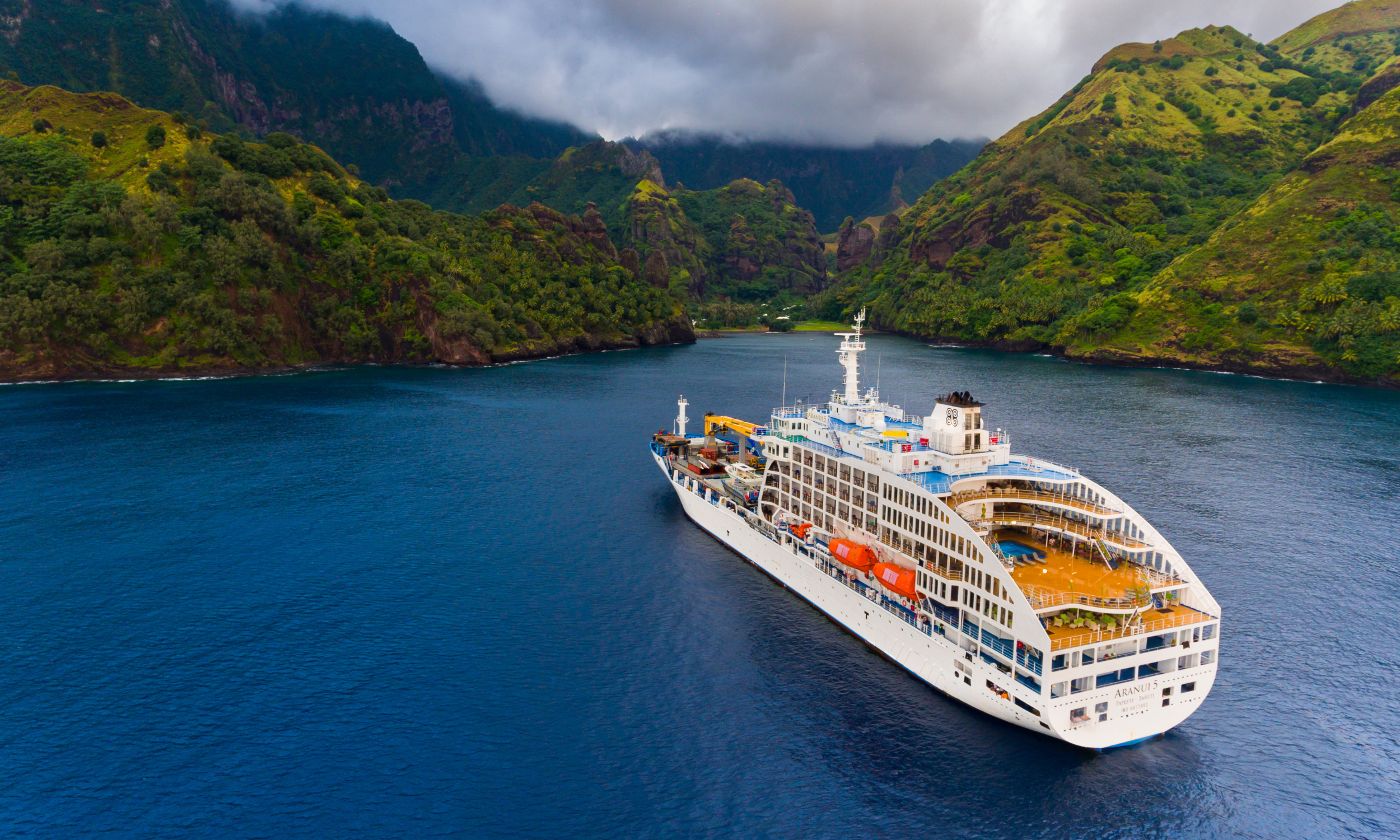
Aranui Cruises’ dual-purpose passenger and cargo ship, Aranui 5, arrives in Fatu Hiva, one of the Marquesas Islands in French Polynesia.
Historically, jumping on a banana boat or tramp steamer was a cheap way to see the seas less travelled, perhaps even for free if you crewed. You went where they scheduled and slept in spartan digs, with no amenities except food. It was a great way to avoid other tourists.
Canada Steamship Lines used to operate cruise ships on the Great Lakes and the St. Lawrence until 1965 when they became a freighter company.
The Royal Mail Ship St. Helena used to take passengers from Cape Town, South Africa, to the remote South Atlantic island of St. Helena, but that ship is now carrying racing cars and equipment for Formula E World Series races.
And the Hanjin Dallas used to take passengers on its trips from Busan, South Korea, to California. But it was sold to an American company that renamed it the President Eisenhower and stopped taking passengers when it mistakenly dumped 23 shipping containers, which were lost overboard.
Containerization, 9/11 and then the pandemic also sank freighter travel opportunities.
But Sage60 has plumbed the depths and found you a few rides you can still take, if you’re able to scramble up ladders in rough seas.
The new company Neoline takes freight and passengers on its modern wind-powered vessel, the Neoliner Origin. It does a monthly loop from Saint-Lazare, France, to Saint-Pierre and Miquelon, to Baltimore and back again in the reverse direction. The ship uses huge mechanical sails as its main propulsion, but it also has diesel engines and luxury cabins for passengers. A full loop costs about $11,000 per person in summer for a 25-metre-square cabin with private balcony, three hot meals a day, use of a gym and passenger lounge. The cheapest trip is Saint-Pierre and Miquelon to Baltimore in winter for about $1,600. Fancy, but you need a certificate of medical fitness and travel visas to board.
There are still a few coast-hugging freighters in Europe, Africa, the Middle East and Asia, sold only through specialty agencies such as Cargo Ship Voyages. While there can be seasickness, your shipmates are mostly crew. They eat well and love to chat with new passengers.
If you’re a professional artist, there are a few container ship artist residencies that offer trips in the interest of exposing artists to a unique view of the world. Italian shipping company D’Amico is one example.
Guillaume Lavoie, 48, is a lecturer and consultant from Chicoutimi who has travelled by freighter for fun. The first time he did it, he boarded a ship in Liverpool for a trip to Halifax. When Sage60 talked to him, he had just cadged a ride on an 18-wheeler truck to see what that was like.
“It’s important to note it’s not cheap,” Lavoie says. He paid $100-$200 a day for freighter travel, but figured it was similar to other adventures in cost.
“Imagine if you were to travel Europe and you factor in for every day the cost of food, housing and travel.”
Lavoie says the cabins are bare but quite comfortable. While you might eat at the captain’s table or get a tour of the bridge, there’s very little to do on board except read, write or think. He found it monastically ideal. He read Moby-Dick slowly, savouring every word.
Lavoie’s second voyage was aboard the Bella Desgagnés, a small freighter/ferry that does a week-long loop starting in Rimouski, Que. It delivers people and containers along the north coast of the St. Lawrence, visiting many towns without road access. The ship has 63 cabins and with meals included. Pricing starts at $1,583 per person, quadruple occupancy for a 10-day ride. They’re swamped, booking for 2028 already.
Lavoie says the Bella Desgagnés had “great cabins with amazing food.”
If you fancy the South Pacific, Aranui Cruises lets you board its island freighter out of Tahiti for trips around the islands within French Polynesia, including a popular one — Pitcairn Island — where the Bounty mutineers landed. Aranui is owned by the same Tahitian-Chinese family that started it 40 years ago, beginning with a single ship bringing goods and 20 passengers to neighbouring islands. Discovering a demand for their trips, they developed a tourism infrastructure and started travelling to remote islands with larger ships and fancy cabins. Deborah Roberts, Aranui’s public relations person, says most passengers are between 60 and 75 years old, but they should be physically able enough to hike, as many islands don’t have paved roads. The company does deliver freight, but now has onboard cruise-like amenities such as lecture series, a tattoo parlour and cultural shows.
“It’s an immersion in Polynesian culture,” Roberts says, noting that their excursions include many archeological sites. She says watching the freight being unloaded is fun, too.
Aranui offers luxury cabins with private balconies and dorm rooms, with fees ranging from roughly $7,000 to $22,000 for 12 nights. Getting to Tahiti is not included. Canadians get a 10 per cent discount for the currency exchange and specials for 2028 come out in August or September this year.
Quebec-based writer Mick Gzowski is freighter-travel curious.

Sage60, the digital sister of Sage, delivers compelling stories on healthy aging, advocacy, and community.
Federal Retirees represents active and retired public servants, Armed Forces, RCMP, judges, and their families.