
From woodworking to well-being
A movement of “men’s sheds” is building community and preventing loneliness among older men otherwise in danger of isolation.
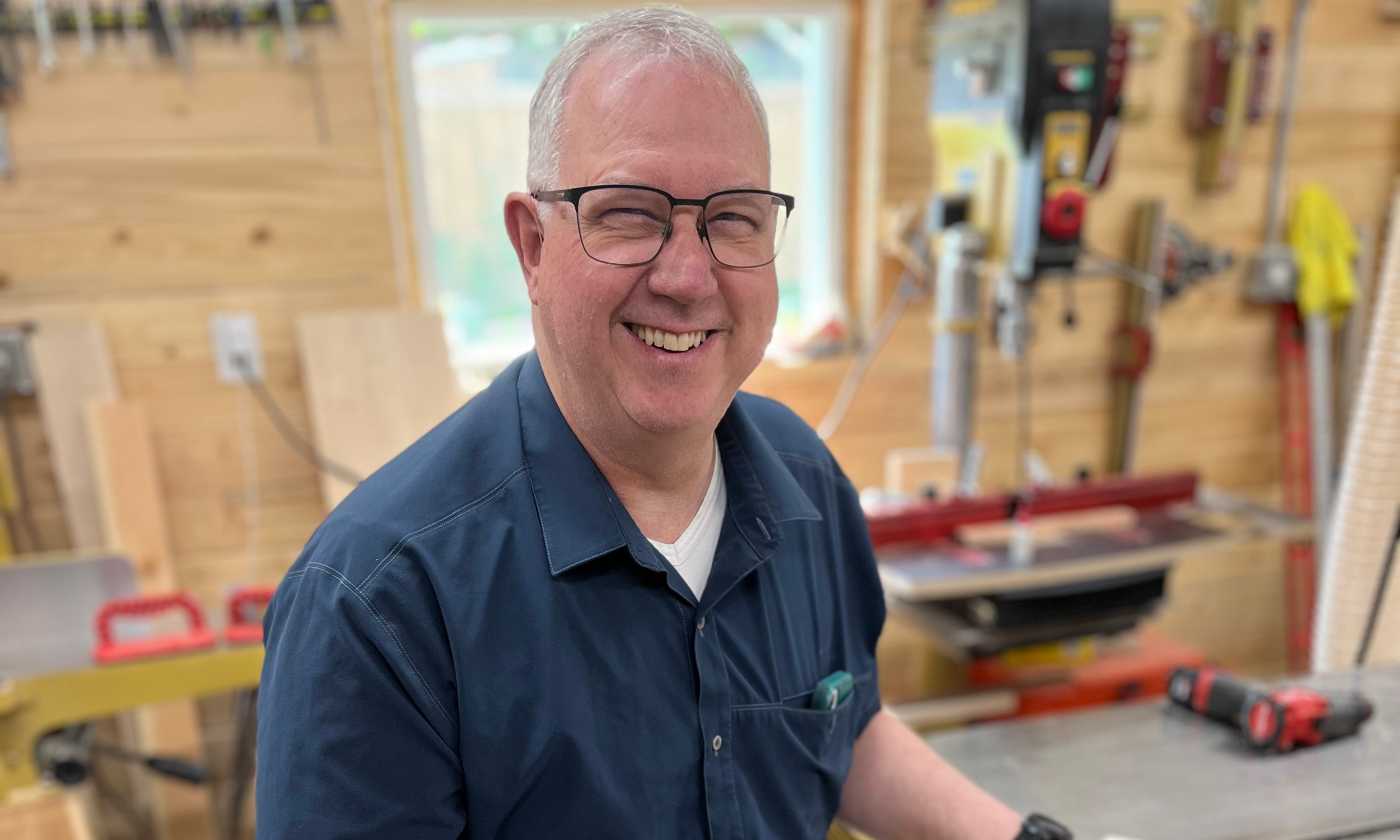
Jason Mawdsley is a member of the Edson, Alta., Men’s Sheds chapter, which he says “really helps us to work through whatever we’re working through.” Photo: Compliments of Jason Mawdsley
In all his deployments as a 26-year member of the Canadian Armed Forces, what resonated for Jason Mawdsley the most were the majestic mountains that surrounded him during his eight years in Alaska. So in 2023, upon his retirement, he and his family decided the Rockies was where they should be. They settled in Hinton, Alta., a 20-minute drive from Jasper National Park.
“In Hinton, everybody knows everybody, but when you’re new to the area, you know nobody,” explains Mawdsley, who was dealing with the death of his father while settling in his new community. “The ability to meet like-minded people in the area was limited.”
He recalled the camaraderie of military life when many members volunteered in hobby shops and he had long enjoyed woodworking. During his last station in Winnipeg, he was president of the local wood hobby club. That was when he first heard of Men’s Sheds Canada, a non-profit organization through which older men could work on projects, make friends and build community connections.
He found a chapter starting up in nearby Jasper and met with the group there. When another chapter was launched in Edson, he checked it out. As someone who enjoys hiking, woodworking and photography, he found a good fit in Edson. He also came across a 90-year-old aeronautics engineer who worked on the Avro Arrow. “It was like meeting a unicorn,“ Mawdsley recalls.
“The meeting was very uplifting for him as well as myself. It [Men’s Sheds] really helps us to work through whatever we’re working through.”
The rapid growth of the movement reflects a growing awareness of the importance of social connection, particularly among older men.
In Edson, the Men’s Shed quickly became integrated in the community. Members organized a Santa Claus parade and they’ve made birdhouse kits for kids to put together. Their challenge has been to find a home, given the high cost of renting. But they hope to tap into the experience of “sheds” that have partnered with lodges, churches, legions and other community organizations to find affordable space.
Canada now has 200 Men’s Sheds, all developed over the past couple of decades, with provincial associations in British Columbia, Alberta, Ontario, Manitoba and Quebec. Others are being developed in Atlantic Canada and Saskatchewan.
The non-profit organization began in Australia 30 years ago when a woman was looking to help her father find a sense of purpose after leaving the workforce. Australia now has more than 1,200 sheds and the organization has expanded to 15 countries, with 3,300 sheds worldwide.
Isolation was highlighted during the pandemic as a health risk for both men and women and loneliness is something more people face as they age and navigate life’s transitions such as retirement, caregiving and bereavement. Even when men have a network, they may be less likely to reach out, points out John Oliffe, Tier 1 Canada Research Chair in Men’s Health Promotion at the University of British Columbia (UBC). As a result, their mental state often remains below the radar. Many men externalize their depression and anxiety through anger, frustration and substance abuse, he says.
The beauty of sheds, Oliffe says, is that they allow men to gather, give to the community and connect with other men in an environment that easily leads to conversations. “One of the reasons Men’s Sheds work is because it’s a low barrier… It’s about doing and takes out the emphasis around talk, but talk occurs,” he observes, adding that it’s about activities and getting things done. “That old adage of ‘shoulder to shoulder’… That’s where you get the conversations.
“If you put [men] in a circle and say: ‘Talk,’ it doesn’t go so well.”
Robert Goluch, president of Men’s Sheds Canada, says while men gather and fix things, listen to speakers or organize outings, what they’re really fixing is isolation and aloneness.
“Sheds are really magical. They give men a purpose, a sense of belonging and they give them friendships,” says Goluch, who describes the gatherings as a type of social intervention. “It’s built on the idea that men open up when they’re shoulder to shoulder, working together. Not face to face.
“We think that Men’s Sheds is a remedy. We also call that ‘health by stealth.’”
Goluch’s shed in Squamish, B.C., connects with the community by offering wood-working workshops for young children where they learn the basics. That, he says, allows the older men to transfer their skills and knowledge to the newest generation.
There are no women members in the organization, but women have been involved in helping launch sheds. They are considered cheerleaders, often helping men get involved in the organization.
Understanding older men’s needs
Men’s Sheds Canada is working to understand the needs of older men and how to support them. There is an intent to work with Health Canada as it develops a strategy from all sectors. It also hopes to tap into funding.
Oliffe attributes part of the Sheds’ success in Australia to significant government investment, something he hasn’t yet seen in Canada. Yet Canada is known worldwide for its early attention to health promotion in the community, he emphasizes.
Men’s Sheds member Danny Williams dove right in when his father, who was going through a difficult time after his wife died, showed him a magazine article about Men’s Sheds. Williams put out word through social media and a shed, with a barn as its meeting place-turned-workshop, soon came to life at Lac-Brome in Quebec’s Eastern Townships.
After Williams’ own wife died, he moved to Montreal’s West Island where he had met another woman. But he didn’t know anyone else in the Pointe Claire community.
“So I thought ‘I’ll start a men’s shed here’,” he reasoned.
That two-year-old club now has more than 50 members who meet regularly at a Royal Canadian Legion branch that has a kitchen where they regularly share their cooking skills.
They have also developed a partnership with an aviation museum where airplanes are being rebuilt and they are developing a new workshop.
Williams said with a network in Pointe Claire now of more than 100 people in just a couple of years, his world has opened up significantly. There are five shed members in his apartment building alone.
“There’s constantly new stuff coming at us and then you make friends, too…. A lot of these guys they don’t have any friends…. The more that you get involved, the more you benefit,” he says.
Organically spreading sheds
Back in Alberta, Mawdsley has helped to develop a shed in his own town of Hinton. And he volunteered to be chair, while simultaneously serving on the executive of the Edson shed.
The men at his shed don’t necessarily sit around sharing coffee, but the workshop creates a place where they can share their backgrounds, skills and interests. “The most important part is it helps our mental well-being,” which is a secondary and tertiary effect of the men’s sheds.
Men’s Sheds inspire women’s versions
The focus of Men’s Sheds is older men and providing a space for them to connect. But women and younger men also play a role in the men’s shed movement.
“Women have played a vital role in the movement from the very beginning,” says Men’s Sheds Canada president Robert Goluch. “They are often our biggest supporters and champions — encouraging husbands, fathers, brothers and friends to get involved, and helping local groups get established. While Men’s Sheds are fundamentally spaces for men, I’ve heard of some sheds that occasionally open their workshops or meeting spaces for special women’s events or evenings.” Goluch says.
In fact, Goluch says a woman started the first shed in Australia three decades ago to help her retired father connect with other men. In Canada, women have been champions, encouraging the men around them to take part and helping to launch new sheds.
Men’s Sheds has also inspired other, unrelated organizations. In fact, Women’s Sheds, considered a parallel organization, operates in Australia, the United Kingdom and Ireland.
In Canada, an unaffiliated group focused on woodworking for women now operates in Vernon, B.C.
Younger men have also been encouraged to join the organization. “Although most Shedders are retired, some of the most rewarding experiences happen when younger and older men are working, learning and teaching together,” Goluch says.