
Canada’s father of biomedical engineering
National Public Service Week series: Jack Hopps benefited from his own invention later in life.
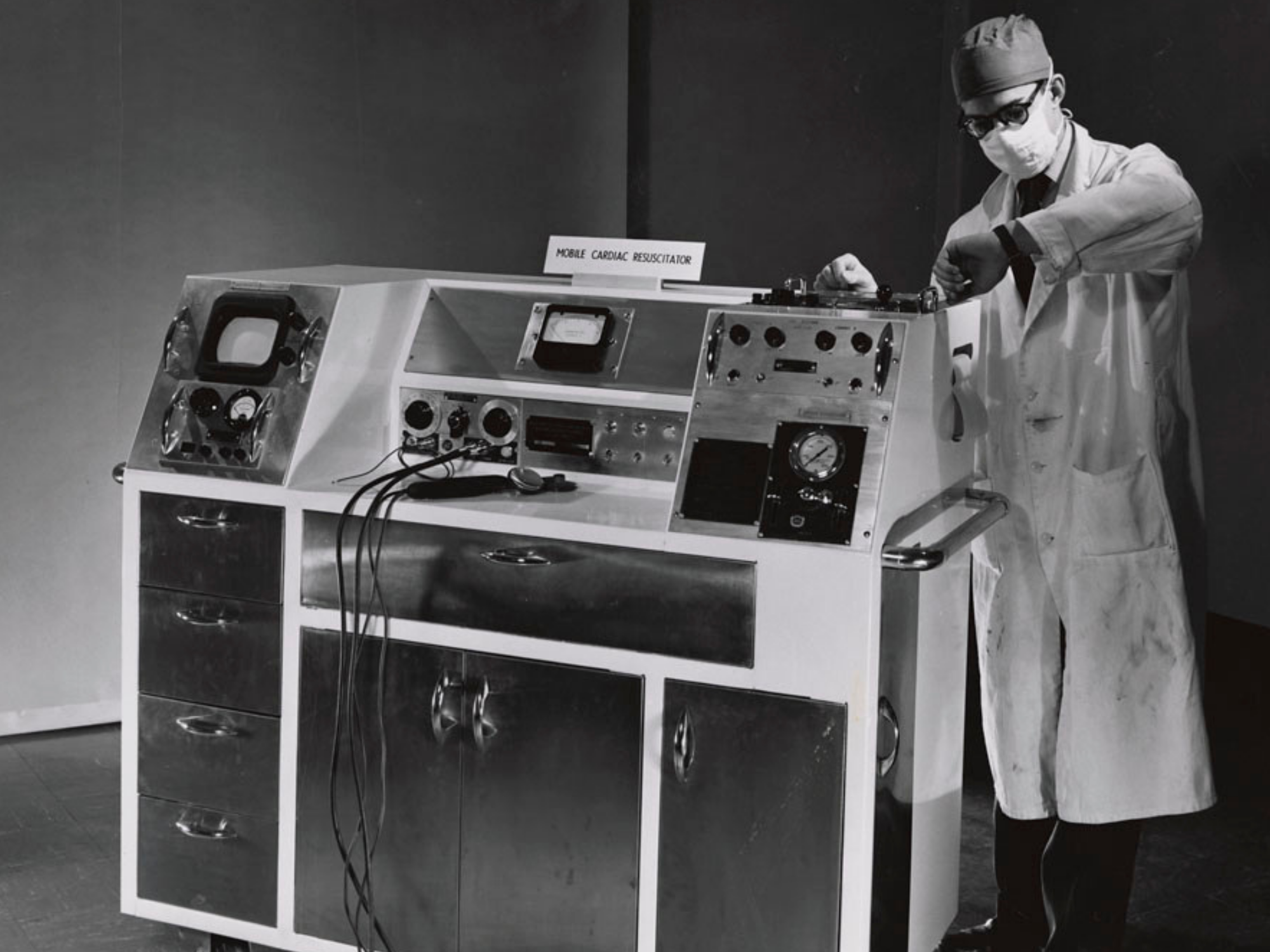
This early Mobile Cardiac Resuscitator helped pave the way for the world’s first external cardiac pacemaker. Photo: Library and Archives Canada.
In honour of National Public Service Week, we present a series of discoveries, innovations and achievements made possible by public servants on the job. Public servants work hard every day in the service of Canadians, and these stories illustrate some of the particularly exceptional work they’ve done to tackle some of humanity’s biggest challenges. From medical breakthroughs to bold, creative problem-solving, we take a look at the talent, skill and gumption they exhibited to get the job done.
To say John “Jack” Hopps took his invention to heart would be an understatement. Hopps is the Winnipeg-born electrical engineer who invented the world’s first pacemaker and, at the age of 65, he actually had his own later-generation pacemaker installed.
In 1949, Hopps was working on the use of radiofrequency reheating for pasteurizing beer at the National Research Council (NRC) when he was sent to the Banting Institute in Toronto. He called the assignment an “annoying interruption to this vital task” of beer research, but many would go on to thank him because it was while working at the Banting Institute that he was studying how to induce cardiac contraction alongside research fellow John Callaghan and cardiac surgeon Wilfred Bigelow, a study that led to the invention of the pacemaker.
As the British Columbia Medical Journal (BCMJ) notes, Hopps “serendipitously observed that the electrical impulse would cause the heart to contract” and “that repetitive stimuli would allow this to occur over a prolonged time.” Hopps and colleagues went on to refine this process and, with the findings, he returned to the National Research Council in 1950 and designed the first pacemaker prototype.
The device looked like a small table radio and used vacuum tubes to generate pulses. Hopps also invented transvenous catheter electrodes, which could be passed through the external jugular vein and eliminate the need to open the chest for heart stimulation. Those same electrodes are used in today’s modern implantable pacemakers, for which Hopps’ invention laid the groundwork.
Speaking to CBC in 1984, Hopps said that in the 1950s, there wasn’t much interaction between doctors and engineers. “The medical people didn’t know the potential of engineering to assist them. And we knew nothing at all about the medical problems.” CBC reported in a series about extraordinary Canadians in 2017 that Hopps called his pacemaker assignment an “ordinary engineering problem” and said he wasn’t surprised when it worked, noting that he didn’t even register as a breakthrough at the time. “I was naïve enough to expect it to work,” he said.
Hopps was known as the father of biomedical engineering in Canada, according to a plaque installed in his memory at the NRC. He and his team also pioneered the use of ultrasound to diagnose and improve the lives of those who are blind and have muscular disabilities. He also continued to advance cardiovascular health by developing machines for respiration, cathode-ray displays for cardiac operating rooms, cardioscopes for post-operative monitoring and heart-rate monitors for sports medicine, the BCMJ writes.
Of the pacemaker, Hopps once said, “It’s really a gratifying thing that the pacemaker has helped so many people. So many people can live a healthy, full life now, whereas they wouldn’t have been able to.”
Hopps had his first pacemaker installed in 1984; 13 years later, when the battery started to fail, he had it replaced. He died in 1998 at the age of 79 of a blood clot.