
Tracking fellow members
Joe Healy has spent 25 years documenting the graves of RCMP members.
He’s now traced everyone who has worn the red serge since 1873.
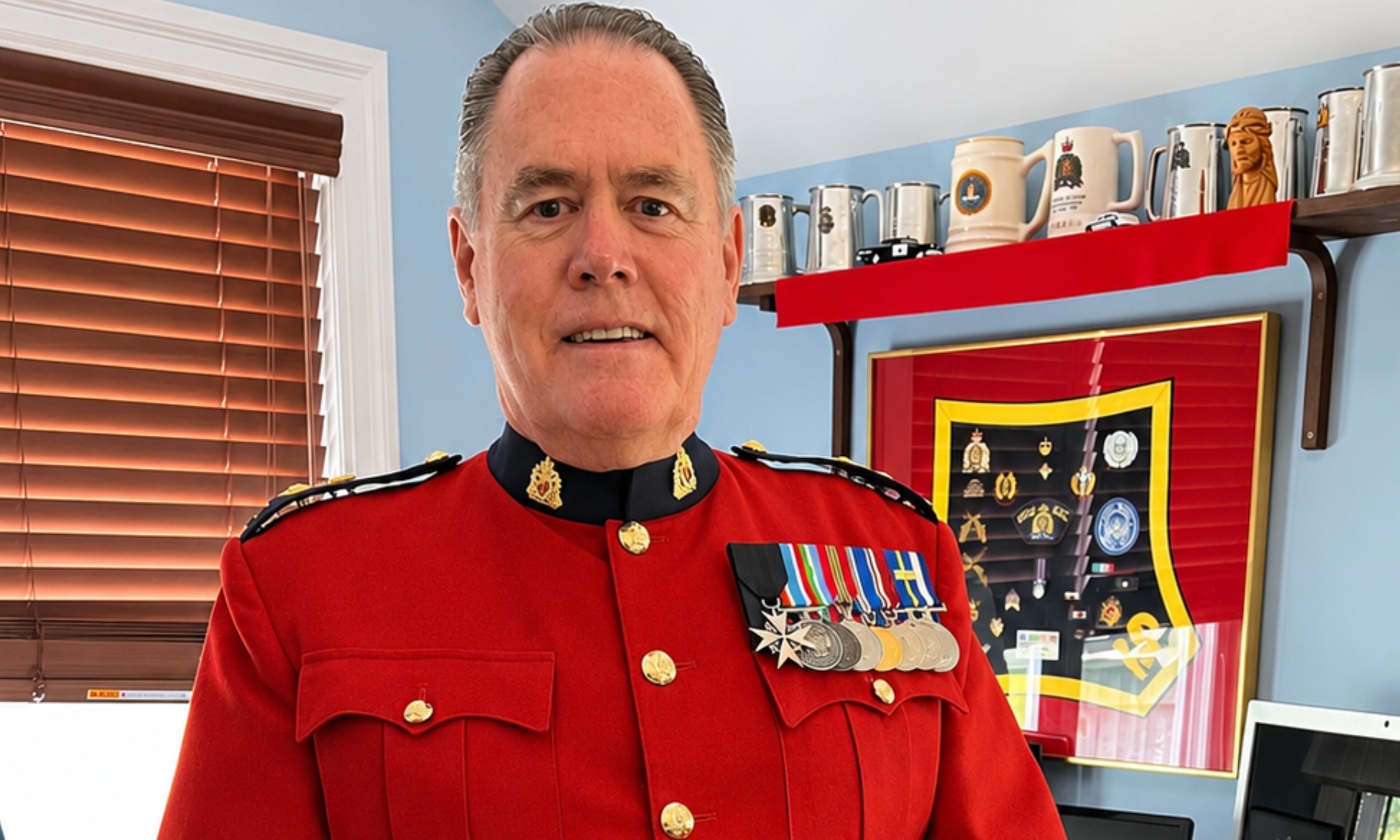
Through his own sleuthing and the help of volunteers across the country, Joe Healy has built rcmpgraves.com, which boasts files on everyone who has worn the red serge since 1873. Photo: Compliments of Joe Healy
In 2001, newly retired RCMP superintendent Joe Healy visited the graves of his wife Cathy’s parents and grandfather at Ottawa’s Notre-Dame Cemetery. Cathy’s grandfather was a longtime member of the national police force, but there was nothing on his headstone to mark his RCMP service.
“He spent 25 years in the RCMP, but nobody would know,” remembers Healy, now 81. “The light went on and I thought to myself, ‘There’s cemeteries with thousands of our members across Canada and around the world — and nobody knows where these people are.’”
So began the quest that would define his next quarter century: to track and document the burial places of thousands of former RCMP officers. Through his own sleuthing, and with the help of volunteers across the country, Healy has built a database and a website, rcmpgraves.com, that boasts files on everyone who has worn the red serge since 1873.
The searchable database offers information on more than 80,000 people who served in the RCMP and its predecessors, the North-West Mounted Police (NWMP) and the Royal NWMP. Each file includes the officer’s name and regimental number; many also include photographs, career histories, biographical data and gravesite information. It also includes special sections devoted to historic RCMP exploits, famed Mounties and those who served Canada in wartime.
One feature tells the story of former hockey broadcaster Don Cherry’s grandfather, who rode in the famed March West in 1874 to pacify the restive prairies. (NWMP Const. John T. Cherry was disciplined for “insolence” and “disobedience.”)
“There’s no police force in the world that has such an elaborate database about its former members,” Healy, a 36-year RCMP veteran, says of his website.
The RCMP has taken an interest in Healy’s work and has asked him to bequeath his database to the police service or the RCMP Veterans’ Association.
Glen Siegersma, the association’s chief administrative officer, said talks about how to continue the database are at an early stage.
Healy is thrilled others see the value of his site. His work has already earned him the Sovereign’s Medal for Volunteers and an RCMP’s Commissioner’s Commendation.
Born and raised in St. Stephen, N.B., Healy joined the RCMP in August 1964 at age 19. He served in Burnaby, Surrey and Maple Ridge, B.C., Regina, Ottawa, Toronto and Prince Edward Island. Along the way, he studied part-time for a bachelor’s and a master’s in education.
In Ottawa, he served on the security detail assigned to prime minister Pierre Trudeau, and escorted Justin Trudeau to his first day of primary school. Later, he trained officers in Namibia, Bosnia and Czechia.
After retiring, Healy learned computer programming to build his database.
News of his endeavour spread among RCMP veterans and Healy was soon inundated with information about RCMP graves, along with obituaries, pictures and stories. He’s particularly proud of recovering the remains of assistant commissioner Alexander Eames, a legendary RCMP officer who directed the epic hunt for murderer Albert Johnson, the Mad Trapper of Rat River, which ended in the Yukon during the winter of 1932.
Eames died in Vancouver in 1965, but his cremated remains sat on a cemetery shelf in Burnaby, B.C., for 44 years until Healy tracked them down. He paid to have Eames’s remains sent to Ottawa and interred at the RCMP National Memorial Cemetery in June 2012.
Healy, who joined Federal Retirees in 2025, devotes eight hours a day to his project.
“The red serge meant the world to me,” he says. “I proudly wore it and still proudly serve it.”