
An aviation passion project
A small band of volunteers dedicated to detail is working to restore the North Star at the Canada Aviation and Space Museum.
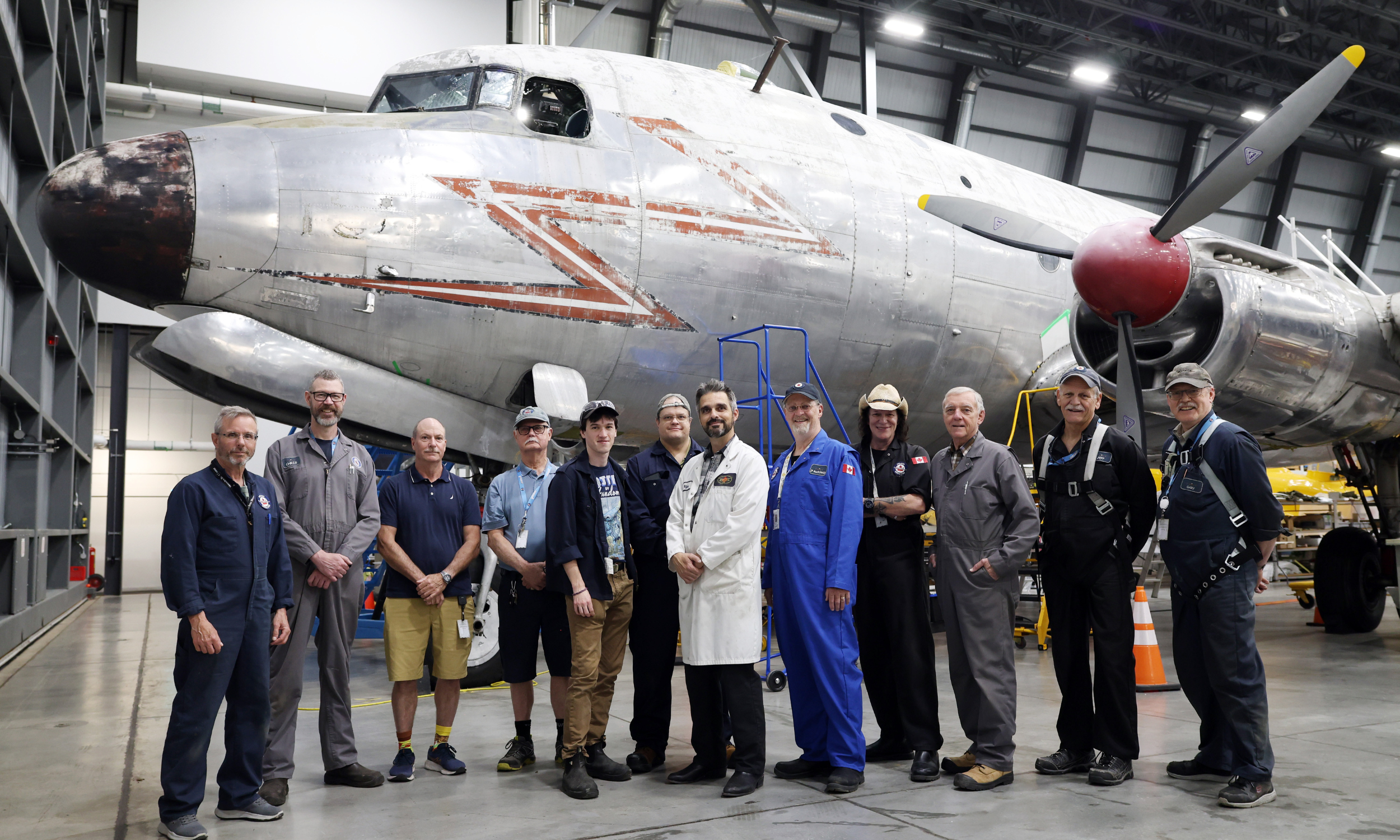
The crew of Project North Star on the day Sage visited the Canada Aviation and Space Museum. From left, Michel Lamarche, Chris McGuffin, Paul DeSerres, Garry Dupont, Evan Boeckh, Charles Baril, Réjean Demers, J.P. MacDonald, Patrick Killen, Richard Houle, Jeff Threader and Gary Roberts. Demers, who works for the museum, manages the project. Photo: Dave Chan
In the back of the Canada Aviation and Space Museum, looking out over the runway of Ottawa/Rockcliffe Airport, there is a workshop that grinds and whirs and clangs with activity. Among the restoration projects that are under way in the shop is one with special meaning for retired Canadian Army Col. Chris McGuffin.
It’s the Canadair C-54GM, known as the North Star, and she is the last intact example of her kind in the world.
“The aircraft is significant because it was Canada’s first strategic airlift from a military perspective,” says McGuffin, one of the people who are donating or have donated their time over the past 23 years to help restore the precious aircraft.
“It was the North Star that gave Canada the lift capacity to support international peacekeeping operations, and I think without the North Star, Canada would not have the same early reputation as a peacekeeping nation that we enjoyed for many decades,” says McGuffin, who is president of the Project North Star Association of Canada, an independent organization of volunteers that’s assisting with the restoration.
The shop, which is only one of several workspaces for the North Star project, is where parts are repaired, restored or even fabricated. Two days a week, volunteer and Ottawa painter Patrick Killen (also known as the singer in Ottawa band Big Jeezus Truck) refinishes and repaints panels and other parts and recalls when his father worked at the museum in the 1960s. “I remember running around underneath all of these,” he says, during a walk among historic aircraft in the museum’s hangar-like exhibition spaces.
On this day, Killen is working on refinishing and repainting the escape hatches that will be refitted into the sides of the North Star. They are just a few of thousands of parts that are being restored. Other parts wait on an upper level of the workshop, or on tables in other rooms. Some may be off site being restored in whatever way is necessary.
McGuffin says he is among approximately 18 current volunteers, and he estimates there have been as many as 80 since the project began in 2003.
“More than 20 were former military or public service personnel.”
The volunteers work under the auspices of the aviation museum and the direction of museum conservator and aircraft maintenance engineer Réjean Demers. Everyone involved is eager to share their enthusiasm for the project, and to share their passion for the plane.
McGuffin and Killen lead a tour out of the workshop and down a hall past rooms of restoration equipment, from an air-tight painting space and a sewing room to metal-working machines and an engine room where a massive vintage Rolls-Royce Merlin engine is being restored. Everything is recreated with meticulous attention to historical detail.
The tour continues through the museum’s display area, past a hulking Lancaster bomber, Spitfires, Hurricanes and many other planes, the smallest ones barely the size of the massive wheels on the largest aircraft. (To stand beneath the open bomb bay of a Lancaster bomber is to feel very small, indeed.) There’s even a Canadarm, supported in permanent position, as the robotic appendage that was so graceful in space cannot support itself in Earth’s gravity.
Out a door and across a tarmac is a second display space. It too is full of fascinating flight nostalgia, such as the tiny and comparatively primitive Fairey Swordfish, “the type of plane that took out the Bismarck,” Killen notes with admiration.
Then there is the North Star, RCAF registration 17515, and she’s a big beauty. She’s white on top with shiny aluminum on the bottom.
Her wingtips are red, as are the caps over each of four Rolls-Royce Merlin 622 V12 engines, pushing out 1,760 horsepower each. It was, by all accounts, a very loud aircraft. It’s almost 29 metres (95 feet) long with a wingspan of just under 36 metres (118 feet) and it was built in 1948 by Canadair in Montreal, on an airframe from the U.S.-made Douglas C-54, with wings and landing gear from a DC-6.
“The main difference is that the Douglas aircraft were powered by Pratt & Whitney engines, where the North Star had Rolls-Royce Merlin engines,” McGuffin says. “The engines gave the North Star 30 per cent more range and speed than the C-54.”
The final North Stars, including RCAF 17515, were retired from service in 1965.
“North Stars constituted the backbone of the RCAF military long-range transport capability for almost 20 years until the mid-1960s,” the Project North Star website states.
RCAF 17515 served many roles, including northern re-supply, humanitarian relief and support for United Nations and NATO operations, and it took part in “the famous and highly successful Operation Hawk airlift of supplies and personnel in the 1950-53 Korean War.”
It had a five-man crew, including pilot, co-pilot, engineer, radio officer and navigator. The cockpit, which somehow seems both vast and cramped, is practically covered in buttons, switches and dials. It was a non-pressurized aircraft, and normally flew below 10,000 feet, though oxygen tanks and masks were installed for use when needed.
Another volunteer, Michel Lamarche, is quietly at work restoring that oxygen system, which involves many tiny lines and other parts. The aircraft will never fly again, but every detail is important to the volunteers and their overseers. Lamarche, who is retired from Immigration Canada, is grateful to be involved.
“I like to work with my hands,” he says. “I like to do stuff. I am not an expert, and I’m not a mechanic or anything like that, but I wanted to work, to learn. I’m a pretty handy person. I like to do all sorts of projects — anything related to fixing things. When they said I could join the team, I was very happy, and I’ve been learning ever since.”
Project North Star began “with a group of aviation enthusiasts who see these machines as more than just wood, metal and fabric,” its website says. The group originally worked to raise funds and recruit volunteers, though in recent years “the museum takes on the burden of recruiting and selecting volunteers, although we do a lot of outreach through social media and our website,” McGuffin says.
The group also sells merchandise to raise funds for the project.
He says Réjean Demers will seek volunteers with a wide range of skills — “people who worked on their cars, people who do home renovations, people who build models, anything that lends itself to manual dexterity and understanding that you can only turn a fastener so hard before it breaks.”
When restoring the North Star, he wrote, “we get absorbed into the weight and breadth of the subject matter. This is the kind of project that demands the level of commitment found in monasteries, dojos and paratrooper units.”
For Lamarche, McGuffin and other volunteers, that has meant learning different tasks and working with different materials. It has recently led McGuffin to the sewing room to work on upholstering so he can restore the seats and other textiles in the aircraft. “I tend to bounce around a fair amount, and right now I’m on fabrics.”
There are no idle moments for the volunteers when onsite. As the tour winds back around the fleets of aircraft crowded into the hangar, the clock strikes noon, but for McGuffin it’s not lunch time yet. “I’m gonna peel off here and get back to the sewing machine.”
To paraphrase Thomas Fuller’s proverb, a stitch in time saves 17515.
In a 2019 report, Demers wrote that volunteers must “strive for quality” and have a “voracious appetite for detail.”