A pioneer among women
June 1, 2026 4 min read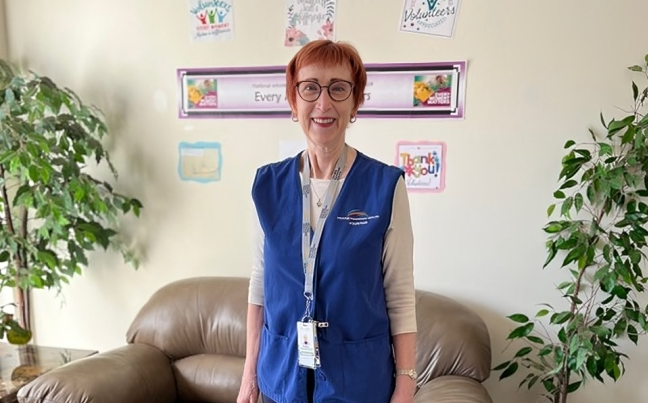
In her career, Kathie King rose to the rank of staff sergeant in the RCMP. In retirement, she volunteers for her local hospital, as seen in the photo above, and for Federal Retirees. Photo: Compliments of Kathie King
A pioneer among women Member Kathie King was part of the second troop of women who joined the RCMP in 1974. Telling a young person that not so long ago all RCMP officers were male may elicit the same incredulous look as when you explain how we used to answer the phone without knowing who was calling, or how people used to smoke on airplanes.
Canada’s national police force was male to the corps, so to speak, until 1974, when “the very first troop of female members” were engaged, says Kathie King. When the second troop of women joined a few months later, King stood proudly among them.
“It was 32 members to a troop,” says King, who was in Troop 36-74/75. “We had [members] from B.C. right straight through to Newfoundland, and one from the Northwest Territories.”
Were they accepted by male Mounties?
“I was 19 years old and I think that’s where ignorance is kind of bliss when you’re that age,” says King, who lives in Brandon, Man., not far from her birthplace of Elgin, Man. There sometimes were issues, she recalls, though often they came from the wider, usually rural communities, where “no one had seen female police officers.”
An example: “One day I answered the phone at my first detachment and someone was reporting an accident, so I said, ‘Well, I’ll come by and I’ll have a look at the damage,’ and the individual happened to be a male caller and he said, ‘Maybe you should send one of the guys.’”
Today approximately 22 per cent of RCMP officers are female, and two commissioners have been women.
“We have female members in every position in the RCMP,” says King, who filled a variety of roles on her upward climb over several decades.
After 11 years in Prairie detachments, she was posted to Major Crime Services, which would assume control of major investigations (outside of larger cities) such as homicides or child sexual abuse. In 2001, she became part of the RCMP’s first integrated Internet Child Exploitation unit. The details and materials viewed were such that psychological visits for unit members were mandatory.
“We did find, though, that the success rate of finding the accused and an arrest rate and conviction rate were very high, so a lot of job satisfaction came from that.”
In 2003, King was promoted to staff sergeant and senior investigative operational supervisor for Major Crime Services for Manitoba and in 2010, she retired.
Today she enjoys travel, and often travels with her friend Ruby Burns, a retired RCMP member who is based in Prince Edward Island. King lists some of the places she’s visited like travel slides clicking through a projector — Madrid, Paris, London, Portugal, Germany and others, often focused on history. She’s been to Juno Beach and Flanders Fields, and Vimy Ridge is on her bucket list.
Next up, however, is Scotland, “and we’ll see where we go after that.” It’s not all travel and sightseeing, she says. “I found in retirement you still need purpose.”
As such, she’s secretary of the Western Manitoba branch of Federal Retirees. She volunteers at a local hospital “just to assist people to get to whatever place in the hospital they need to be.” Her other volunteer work more directly uses her expertise from decades in fighting crime. She’s on the board of directors for the Canadian Centre for Child Protection and is an RCMP consultant for the Canadian Virtual Hospice.