
Canada’s robotic triumph
National Public Service Week series: Public servants at the National Research Council worked alongside private-sector companies to build the Canadarm.
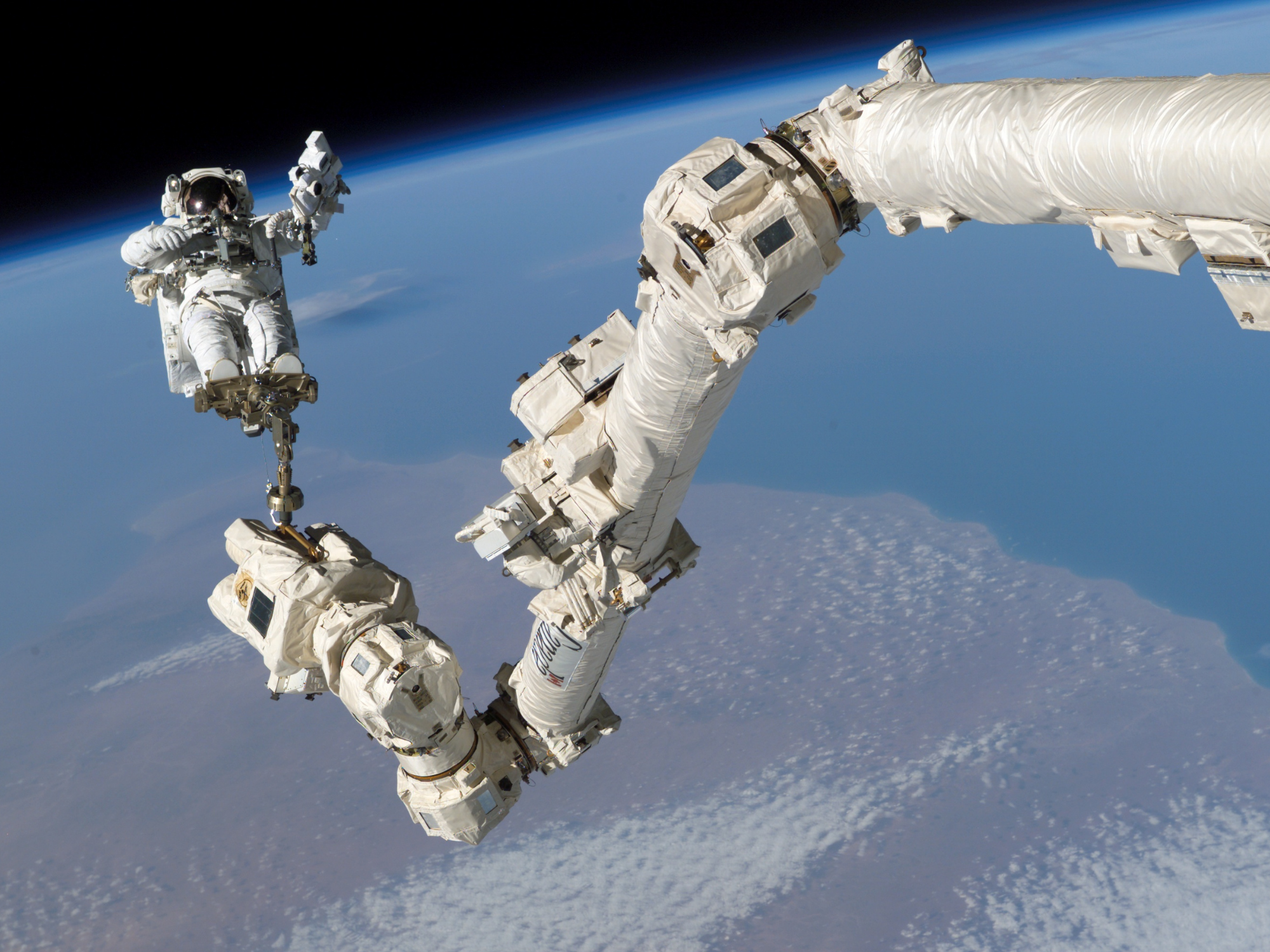
Astronaut Stephen Robinson anchored to a foot restraint on the International Space Station’s Canadarm2 during a spacewalk in 2005.
In honour of National Public Service Week, we present a series of discoveries, innovations and achievements made possible by public servants on the job. Public servants work hard every day in the service of Canadians, and these stories illustrate some of the particularly exceptional work they’ve done to tackle some of humanity’s biggest challenges. From medical breakthroughs to bold, creative problem-solving, we take a look at the talent, skill and gumption they exhibited to get the job done.
When Canada wanted to lend a hand to space exploration, federal employees helped to build an arm.
More than 30 years later, the Canadarm is a triumph of research, engineering and even diplomacy. It established Canada’s reputation in space robotics, a highly specialized field. It remains, the Canadian Space Agency (CSA) says, “Canada’s most famous technological achievement in the field of robotics.”
Private companies that were involved in building the Canadarm were supported through the Canadian government’s young and growing space program. Experts at the National Research Council worked quietly in the background, not often seen in news stories about the new and unprecedented tool. With more than $100 million in federal funding, NRC employees oversaw the robotic arm’s development.
The NRC and Spar Aerospace started to develop the arm in the mid-1970s. Bilateral agreements between NASA and the NRC had fuelled the public-private project, which involved NRC specialists and 25 private-sector firms.
The immense challenge was, as a CSA webpage puts it, “to build a tool to function flawlessly in space with the dexterity of a human arm.”
The dexterity has been demonstrated by the wide range of tasks that the Canadarm has successfully undertaken. Over three decades, a series of Canadarms installed on NASA shuttles have helped to launch satellites into orbit and capture them for repair. They helped to build the International Space Station, and used IMAX cameras — another Canadian invention — to film astronauts in space, among many other tasks.
The first Canadarm was given by the Canadian government to NASA, a gift that was later reciprocated when Marc Garneau joined a shuttle crew and became the first Canadian in space.
That first Canadarm rocketed into space on Nov. 12, 1981, and over 30 years it and four other Canadarms aided NASA on various missions. The device’s final flight was in 2011 on the shuttle Atlantis, after which the original Canadarm was replaced by the Canadarm2. The Canadarm3 is scheduled for delivery as soon as 2029, and will take part in the Gateway project to build a lunar base for exploration of the moon.
The robotics research that started with Canadarm has led to profound Earth-bound benefits, especially in medicine. The neuroArm is the first robot that can perform surgery inside MRI machines and has helped people whose conditions were inoperable with prior technology. The Image-Guided Autonomous Robot (IGAR) is another offshoot that, when complete, is expected to greatly improve treatment of breast cancer. Modus V, a robotic digital microscope introduced in 2017, has been used in hospitals across North America, aiding surgeons in the treatment of brain and spine conditions. All of these devices grew from the research that began with the Canadarm.
The CSA says the Canadarm “is a symbol of Canadian ingenuity, precision and reliability [and] demonstrated that Canada could contribute cutting-edge technology to humanity’s greatest challenges.”
It never would have happened without the support and expertise of federal employees.
Fast facts about Canadarm
- It weighed 410 kilograms, and though it was powerful and flexible, it couldn’t support itself in Earth’s gravity.
- It could lift more than 30,000 kilograms, “or up to 266,000 kilograms in the weightlessness of space,” says the Canadian Encyclopedia. It did so while it used less power than it took to boil an average teakettle.
- The original Canadarm was built as a series of five for NASA. One is now on display at the Canadian Aviation and Space Museum.