
Chair today, strong tomorrow
Chair yoga and tai chi are both beneficial and particularly helpful for those who have mobility challenges.
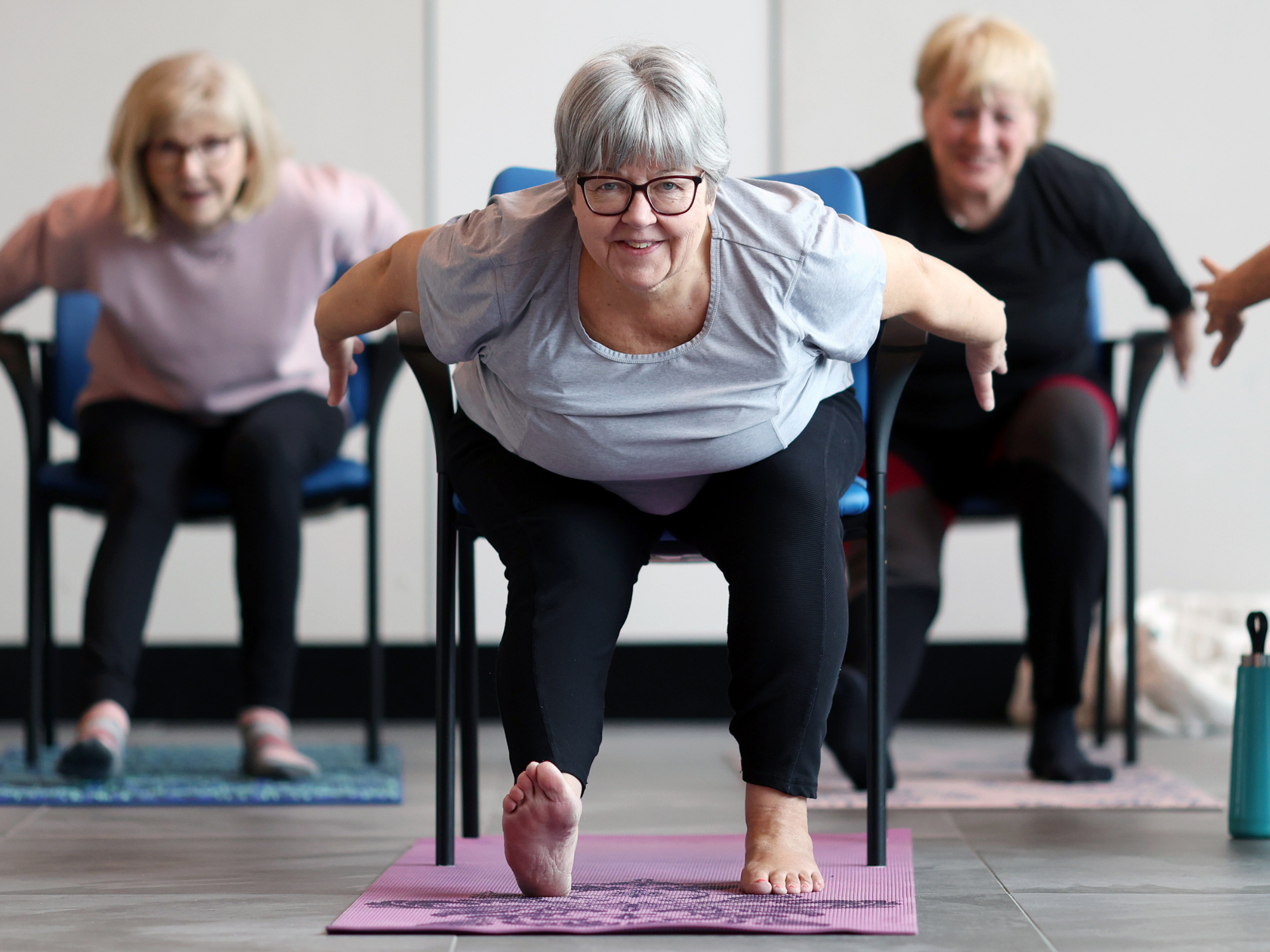
Ottawa resident and member Lisa Rudyk, centre, is seeing the benefits of chair yoga, which provides a stable base from which to exercise and can alleviate pressure on achy knees and wobbly ankles, according to Harvard Health. Photo: Dave Chan
When Linda Schneider was recovering from a broken hip, she knew from her doctors and common sense that she needed to be doing regular, gentle exercise.
A friend suggested tai chi, which she tried, but she found the movements too challenging to do and too numerous to easily remember.
Her friend next suggested chair tai chi, an approach that has recently been gathering a lot of attention and allows people who are older or somewhat fragile for other reasons to benefit from this Eastern movement practice that was once a martial art and has been called “meditation in motion.”
Schneider, of Peachland, B.C., took to it immediately. “I loved it,” she recalls. “You use all your muscles and all your joints. Everything is working better, and I’m not seeing my chiropractor nearly as much.”
In Ottawa, Lisa Rudyk, for the last year and a half, has been doing chair yoga, which, like chair tai chi, is an adaptation of an Eastern practice.
“I have sciatica, shoulder problems and a bit of a problem with mobility, but the yoga really opens things up,” she says. “And it’s focusing. It calms your mind, and you leave feeling better than when you walked in.”
Schneider and Rudyk are both grateful for the benefits they have gained from chair exercises, which are well-recognized as a valuable way for older people to build strength, release bodily tension and assume greater responsibility for their own ongoing comfort in their body.
Harvard Health, which is published by the health education division of Harvard Medical School, lays out the potential advantages succinctly: “… as you age, you may not be able to do the same exercises you could perform easily in your 20s — or even 50s and 60s. That’s where chair exercises come in, particularly if you have challenges with balance or mobility at any age. Chair-based workouts can help you build and maintain strength, flexibility and endurance. The chair also provides a stable base from which to exercise, and can alleviate pressure on achy knees or wobbly ankles.”
Schneider has been doing her chair tai chi at the Wine Country Tai Chi Society in West Kelowna, run by Doug and Yvonne Waines. Yvonne Waines has been working with tai chi for decades, often in tandem with her daughter, Michelle Greenwell, who runs occasional retreats with Wine Country’s clients, besides also running the Greenwell Center for Holistic Health in Mabou on Cape Breton Island. She has several degrees in the wellness area, including a PhD in complementary and integrative health.
In an interview from Mabou, Greenwell says that 20 years ago she and her mother spent a year and a half doing a “deep dive” into chair tai chi. The seated form of tai chi back then was considered a starting point from which a practitioner could develop enough strength and bodily awareness to proceed to standing tai chi. Many practitioners working with her now will only be doing the chair tai chi, which is more than enough.
“It will change you,” she says. “You are going to be able to put your body back in harmony. If you have an imbalance between organ systems, bad posture, poor movement patterns, all this can improve over time as you learn how your body functions.”
The movements tend to be slow, continuous and fluid. The practitioners need to be as mindful as possible of what they’re doing. At moments, practitioners may adopt a standing posture for particular movements that lie within their limits. Most of the time, however, the activity is done seated.
It calms your mind, and you leave feeling better than when you walked in.
While Greenwell says even teenagers can benefit from seated tai chi (“I’m sure you’ve seen their atrocious posture …”), most clients are in their senior years.
“The senior years are when the value of understanding your body becomes really important,” she says. “You have a vested interest in knowing how to use it.”
A feeling of progress usually comes soon, she says. “You can be off to a good start on day one, but there’s no sense that things should move fast.”
She keeps the presentations simple. “I only ask participants to remember two things from each class and to explore them through the week at home. Eventually, it leads somewhere. If they try to remember everything — and that’s what everyone does at first — they lock up.”
Eventually, participants will be doing all 108 movement patterns that make up the standard tai chi set.
Should you consult a doctor before beginning this practice? “The only reason you’d need a consultation would be if you had a body part that offers a challenge. And if anything is sore, we work at only 40 per cent effort so we don’t make anything worse.”
There has recently been an online flood of ads for chair tai chi that suggests that a mere seven minutes a day can turn a practitioner into a robust and toned Greek statue. Clearly not a believer, Greenwell chuckles when asked about them. “It isn’t real, but if they encourage interest that brings people to actual tai chi classes, that’s awesome.”
Back in the National Capital Region, chair yogini Lisa Rudyk practises at the Karuna at Home Virtual Wellness Community at the Aline-Chrétien Health Hub in Orleans. The instructor, Janet Mcgeein, besides having advanced qualifications for teaching yoga, boasts certifications in aqua, pilates, cardio and personal training.
“Chair yoga is a great practice for anyone, but especially for people with limited mobility or balance issues. There’s lots of stretching and muscle building, and we take great care to accommodate individual challenges.”
Mcgeein has a specialization in post-rehabilitation fitness, particularly for people who have recently had major surgery, such as knee or hip replacements, have neurological challenges following stroke or brain injury, or have problems with mobility.
Four chair yoga classes are offered each week. The classes are also available online.
Schneider and Rudyk are both proud members of the National Association of Federal Retirees Okanagan Branch in Kelowna, on a double membership with her husband Gordon, a retired RCMP officer.
Rudyk, who retired from the Department of National Defence four years ago, admits that she was first drawn to the association because of the travel insurance. She adds that she now loves Sage magazine because of the range of topics and the opportunity to see how retired people such as herself face the challenges of their respective situations.
If you decide to begin chair yoga or chair tai chi, you will need to find an instructor. But how will you know when you have found a good one?
“If you sense the teacher understands how movement works, and you’re enjoying the instructor and the exercises, you’re probably in a good place,” Greenwood says.