
Cross-country must-sees
By Peter Zimonjic Dec 23, 2025 10 min read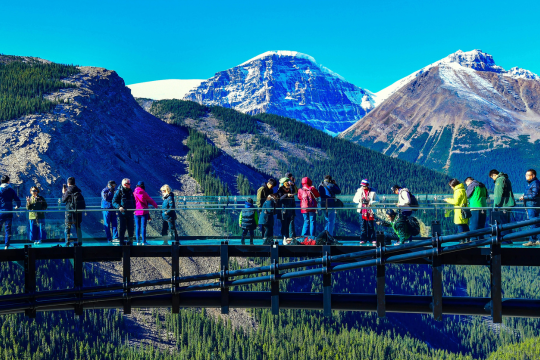
From coast to coast, Canada is full of lesser-known must-sees, and Alberta’s Columbia Icefield Skywalk is one that delivers a jaw-dropping view.
We stop at every province and territory to offer you a sight that you must not miss. Anyone planning a trip across Canada or even across a province will likely have an idea of the big things they want to see. In Ontario, that list might feature iconic sights such as Parliament Hill in Ottawa, the CN Tower in Toronto or Niagara Falls. In Quebec, that list might include the Château Frontenac, in Newfoundland and Labrador, Signal Hill, and in British Columbia, perhaps it’s Whistler. But all across the country, there are lesser known highlights — hidden gems — that stand on their respective hilltops and scream “Canadiana.” Here is a look at some of the not-so-well-known stops that are worthy of a visit on any sojourn in the country.
1. Northwest Territories: The Arctic Ocean Sign
Travelling to the Northwest Territories is an adventure at any age. Some go to climb mountains or shoot rapids, but for those with a more comfortable vacation in mind, why not take a comfortable and warm vehicle up the Inuvik-to-Tuk Highway, the first road to reach the Arctic Ocean in North America? Along the way, there are spectacular vistas of Canadian nature and, at the top of the world, you can even go for a swim and take a picture next to the Arctic Ocean Sign in Tuktoyaktuk, N.W.T.
Accessibility: The road to the Arctic Ocean Sign is a year-round all-weather road. Once at the sign, the ground is flat.
2. Yukon: Jack London Museum
While many Canadians have never been to Yukon, anyone who has read a Jack London novel such as Call of the Wild or White Fang, cannot help but feel the beating heart of the place that exists in their imaginations. The Jack London Museum and Cabin in Dawson City allows visitors to dig into the author’s adventures before, during and after the Klondike Gold Rush. London lived on the North Fork of Henderson Creek in the winter of 1897 and what remains of his cabin has been used to build a replica of his dwelling. Brushing up against London’s legacy is a must for anyone making it as far north as Yukon.
Accessibility: Open from May to September, the museum is wheelchair accessible.
3. Nunavut: Iqaluit
Anyone adventurous enough to fly to Iqaluit should not limit themselves to seeing just one thing in this remarkable Canadian city. Those with a passion for adventure can take a snowmobile tour, go dogsledding or try their hand at igloo-making. Those looking for a more mellow experience can visit the town shops that sell Indigenous art and clothing that will surely set them apart when they return back to the south.
Accessibility: Because of its icy weather, wheelchair users may find this city a struggle at times, but a bylaw passed last year requires taxi companies to have at least one vehicle that meets accessibility standards.
4. Newfoundland and Labrador: L’Anse aux Meadows and John Cabot’s ship in Bonavista
Newfoundland and Labrador has the distinction of being a place where one can immerse oneself in the history of the European discovery of North America from the age of the Vikings right up to the age of discovery. On the Great Northern Peninsula lies the remains of the first known evidence of Viking settlement in what is now Canada — L’Anse aux Meadows. The UNESCO World Heritage site recognizes a former settlement that is thought to be more than 1,000 years old. Visiting the remains of the Viking settlement, visitors can hear costumed interpreters tell Viking tales and examine original artifacts. Back down the west coast is Bonavista, where, in 1497, Venetian explorer Giovanni Caboto — a.k.a. John Cabot — became the first European during the age of discovery to land on North America. Cabot’s journey can be credited with bringing the English language to Canada. Visitors to Bonavista can visit a full-sized replica of his ship, The Matthew, going below deck to see how sailors of the age lived while they hear tales of life at sea.
Accessibility: The L’Anse aux Meadows visitor centre and washrooms are wheelchair-accessible. An all-terrain wheelchair is available upon request. The Matthew replica is housed inside a building and can be boarded by way of a short staircase.
5. Nova Scotia: Maud Lewis painted house
Canadian artist Maud Lewis was born, raised and died in Nova Scotia and is lauded as an icon of the land where she spent her life. Beginning her career as a child making Christmas cards her mother could sell, Lewis spent much of her life living with her husband Everett in Marshalltown, Digby Co., where she supported the two by selling her distinctive paintings. The pair lived without plumbing or electricity, but over the years Lewis painted the house inside and out, turning it into an artwork that is a must-see on any journey through this picturesque province. The house was fully restored in 1996 and is now on permanent display in Halifax at the Art Gallery of Nova Scotia.
Accessibility: The Art Gallery of Nova Scotia is wheelchair-accessible, with elevators in both buildings.
6. New Brunswick: Hopewell Rocks Provincial Park
Canada has many natural wonders and the massive tides in the Bay of Fundy that have prompted the ocean to carve its way through Hopewell Cape is one New Brunswick-bound travellers should not miss. Park admission is valid for two days to ensure visitors get to see the high and low tides that have made Hopewell Rocks Provincial Park such an iconic Canadian landmark. For walkers, a descent to the beach to walk the ocean floor amongst the nearly two dozen freestanding stacks jutting out from the sand promises to be a memorable experience. There’s also a 99-step climb to a viewing platform and a ramp that takes visitors right down to sea level.
Accessibility: At the park’s North Beach, there’s a ramp with benches along its path. It will allow wheelchair users to get to sea level, but pushing out onto the sand is not recommended
7. Prince Edward Island: Stompin’ Tom Centre
Anyone with passion for all things Canadian will want to visit the Stompin’ Tom Centre, located on the westernmost part of P.E.I.’s North Cape Coastal Drive. Connors was born in Saint John, N.B., but grew up in Skinner’s Pond, P.E.I., after being adopted by an island family. Every day from 1 p.m. to 2 p.m., there is free live music that visitors who’ve come to see Connors’ guitars and other memorabilia can enjoy.
Accessibility: The centre is wheelchair-accessible.
8. Ontario: The Diefenbunker
For those who have pondered the dark fears that hung over Canadian society during the Cold War, a visit to the Diefenbunker, in Carp, Ont., will be an eye-opener. In 1959, prime minister John Diefenbaker commissioned the bunker to house 535 government and military officials for a 30-day period in case of a nuclear attack. Up and running by 1962, the bunker was built to withstand the impact of a five-megaton nuclear bomb from a distance of 1.8 kilometres away. Visitors will see the prime minister’s suite, the war cabinet room, the medical centre and the Bank of Canada vault.
Accessibility: Upgrades to make more of the bunker accessible have been made, but there are still tripping hazards and obstacles that may make access to some parts difficult.
9. Quebec: Baie-Saint-Paul
Located about an hour west of Quebec City, along the St. Lawrence River is the province’s Charlevoix region. Baie-Saint-Paul is a treasure not to be missed. Visitors can walk along the shore, hop on a boat for a whale-watching tour or take a short ferry to L’Isle-aux-Coudres. The narrow winding street that snakes through town from the church to the north is dotted with art dealers, galleries, restaurants and cafés that allow visitors to smell, touch and feel the vibrancy of this artist hub without having to tread too long at street level.
10. Manitoba: The centre of the country
If you’ve already taken a selfie at the Arctic Ocean Sign in Tuktoyaktuk, N.W.T., why not complete the set with a photograph at the geographic centre of Canada? Sitting in the rural municipality of Taché, about 40 kilometres east of Winnipeg, is a spot has been dubbed the east-west centre of the country and has a sign to prove it.
11. Saskatchewan: Little Manitou Lake (Canada’s Dead Sea)
While the province of Saskatchewan is home to more than 100,000 lakes, Little Manitou Lake, about 116 kilometres southeast of Saskatoon is unique for its highly salted water and rumoured capacity to heal and rejuvenate swimmers with its mineral waters and rich mud that visitors use to cover their skin. The salt content in the lake is about five times that of the ocean and about half that of the Dead Sea, which means there is almost no aquatic life. A dip in the water leaves swimmers effortlessly floating under the massive Saskatchewan sky.
12. Alberta: Columbia Icefield Skywalk
Alberta is home to two of Canada’s most visited national parks — Banff National Park and Jasper National Park. For those who are looking for a little adventure, without having to trek up a mountain, the Columbia Icefield Skywalk in Jasper National Park may be just the ticket. Perched 300 metres above the floor of the Sunwapta Valley, the glass-bottomed curved walkway offers visitors unobstructed views of the snow-capped mountains. Visitors can also venture onto the glacier in an all-terrain Ice Explorer.
Accessibility: The glass walkway is wheelchair-friendly. Two Ice Explorers are also equipped with wheelchair lifts to bring guests out onto the glacier
13. British Columbia: Haida Gwaii
Haida Gwaii is an archipelago located off the Northern Pacific coast of British Columbia. Access is by plane, boat or ferry. An archipelago bursting with unique plant and animal life, Haida Gwaii is home to the Haida First Nations people. To learn about their unique culture, a visit to the 20,234-hectare Haida Heritage Centre at Kay ’Llnagaay is a must. The centre was built to resemble the traditional oceanside Haida village that once stood in its place. Tourists can visit longhouses, and see decorated canoes and totem poles that reflect the archipelago’s cultural history.
Accessibility: The Haida Heritage Centre is flat and wheelchair accessible, but accessing some of the outdoor locations involves uneven ground.