
Dementia-friendly cities
Apr 1, 2026 7 min read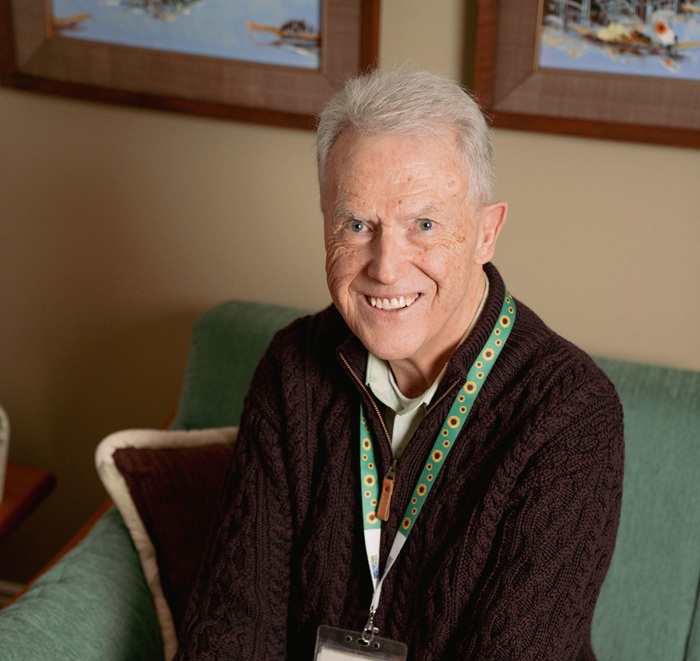
Jim Mann, who spent his career working for Air Canada, was first diagnosed with dementia in 2007. He’s been volunteering for the Alzheimer’s Society of British Columbia ever since. Photo: Mohammed J. Alsaber
A few years ago, Jim Mann took Vancouver’s SkyTrain into the city’s downtown core for an appointment.
Having lived and worked in Vancouver for decades, he knew the city well, but after his meeting, Mann walked out the front door of the building and something strange happened.
“I became disoriented,” he told Sage. “I was standing there going: ‘I have no idea where I am, nor do I know where I’m going or why.’
“So much of wayfinding for people living with dementia is really in the moment,” Mann added. “Some days you’re going to make it all around the block and there’s no problem, and other days you’re going to get halfway and be disoriented.”
Mann, 77, was first diagnosed with dementia in 2007, and since then, he has worked on and off with the Alzheimer Society of British Columbia to help improve the quality of life for the increasing number of Canadians living with dementia.
The Dementia-Friendly Communities initiative
The Alzheimer’s Society of Canada estimates that at the beginning of 2025, there were almost 800,000 Canadians living with some form of dementia, with more than 400 new cases being diagnosed every day.
With Canada’s population continuing to age, the number of people living with dementia is expected to increase to 1.7 million by 2050, the advocacy group says.
To prepare the country for that future, and make life better in the present, Mann — who is on the Alzheimer’s Society of B.C.’s board — has been helping the advocacy group with its DementiaFriendly Communities initiative.
The Alzheimer Society of B.C. started the initiative in 2015, and it’s now a panCanadian effort, with provincial wings of the advocacy group sharing best practices and working together through The Alzheimer Society of Canada’s Dementia-Friendly Canada project.
“In a nutshell, a dementia-friendly community is a place that is welcoming, supportive and inclusive of people living with dementia and their care partners,” says Heather Cowie, the manager of community engagement at the Alzheimer Society of B.C. “The initiative itself looks slightly different in each province, but across the board it’s working with every workforce sector, from transit to library professionals, to the food and beverage industry, to legal professionals, you name it.”
The initiative is not particularly complicated, nor expensive, but what it does require is the capacity to understand what others are going through, and a willingness to help.
Linda Garcia, a professor emeritus, of the University of Ottawa’s Faculty of Health Sciences, spent her academic career focusing on improving quality of life for people who are aging, particularly when they’re living with dementia.
She says making communities more dementia-friendly is really about breaking down the stigma of the disease and treating it like any other disability.
“There was a time several decades ago where when somebody was using a wheelchair we would say: ‘Well that’s it, you can’t go to work, you can’t do this, you can’t do that,’ and now we talk about an accessible world,” she says. “Take this and apply that to dementia. Dementia is a health condition that people are afraid of — they only see the disease and they forget that people who live with dementia also want a life.”
Society needs to adjust
To that end, she says, we need to make societal adjustments that are equivalent to ramps and elevators for wheelchair users, but do it from a cognitive standpoint.
Such “cognitive ramps” come in many different forms and have a physical and intellectual component. By understanding the challenges of someone living with dementia, for example, finding their way around their community, solutions can present themselves.
Allen Power, a geriatrician, author and the Schlegel Chair in Aging and Dementia Innovation at the Schlegel-UW Research Institute for Aging, which is partnered with the University of Waterloo, says sometimes those solutions can be quite simple.
“A sign next to a bathroom door that shows a silhouette of a man or a woman may not mean toilet to someone with dementia,” Power says. “What can be done is to instead put the word ‘toilet’ on the sign — because a lot of people with dementia can read well into their illness — and put a picture of a toilet so it’s clear what is behind the door.”
The Alzheimer’s societies across the country encourage simple ideas along these lines by reaching out to municipalities, libraries, public transit operators, banks and other businesses to offer free education sessions.
“A lot of people have a misunderstanding about what dementia is and what it’s like to live with,” Power says. “The antidote to fear is education.”
He also says an important component of any initiative to make communities more dementia-friendly is including those living with dementia in any education programming. The best “approach is to talk to people with dementia, bringing them into the solution so it’s not something imposed on them but rather something constructed between those with dementia and those who do not have the condition [and who] want to help them,” Power says.
Working together, these education programs have helped those who serve the public to better understand the challenges people with dementia face and how to approach and help them.
Experts say part of that starts with addressing other environmental factors that make life difficult for aging Canadians: making sure public spaces like airports are not overly noisy, bright or rife with confusing signage.
Addressing such things [lightens the load] on the cognitive side, Garcia says.
Lightening the load in other ways
Cowie notes that people with dementia often need benches to help break up long walks or make waiting for transit easier, but meeting that demand is not just about installing more benches, she says.
“In a park, on their way to go get a coffee or on the way to a doctor’s appointment, a bench is really helpful, but does the bench look like a bench?” she asks. “Because if the bench looks like a public piece of art, a person living with dementia may no longer recognize that as a place to sit, just as a really cool piece of art.”
The Alzheimer’s Society of B.C. has helped Vancouver International Airport refine its sunflower lanyard program, making the airport more dementia friendly.
The hidden disabilities sunflower program is a simple and subtle way that people can advertise they have challenges that might not be apparent. Airports across Canada and the world that are a part of the program offer free lanyards to people who need them. Staff trained in how to assist passengers with these lanyards make a special effort to help them navigate business, airports and other public-facing services using skills they have been taught by groups such as the Alzheimer Society.
Cowie says her team walked through the Vancouver airport pointing out where confusion may occur, where things could be better and what was working well, and all of their recommendations were adopted.
“The first time I wore the lanyard, we were going through the airport and I heard three words being uttered by an agent at the security area: he actually said ‘take your time.’ I’ve never heard ‘take your time’ before, but that’s what the sunflower lanyard does,” Mann says.
Experts, advocates and those living with or caring for someone with dementia tell Sage that when people are diagnosed with the condition, it hits their confidence. They will often be afraid of going out, worried they may get lost or fall, which means they stay home, becoming more isolated and worsening their condition.
“To have a good quality of life, you need a safe place to live, you need something meaningful to do and you need someone to love,” Garcia says. “So if we make the world a little bit easier for someone to travel, they are able to continue with their life. It isn’t over for them.”