The smaller the better
By Peter Simpson Dec 12, 2025 7 min read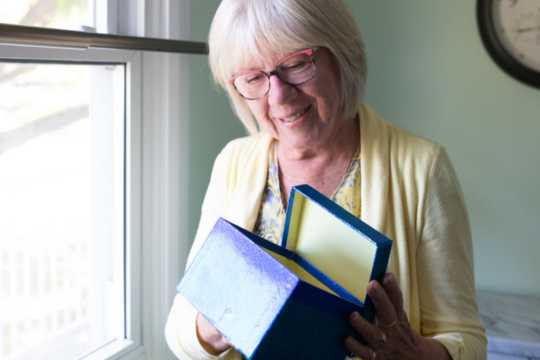
Margaret Dickenson, an Ottawa-based cookbook author and TV host, sits next to the tiny rock she picked up at Juno Beach on France’s West Coast in 2017. It helps her to remember how many Canadians fought for peace, especially now, when peace seems to be slipping away. Photo: Ashley Fraser
Small gifts abound in pop culture, from the dramatic (the simple sleigh — “Rosebud!” — that echoed to the very last moment of the titular man in Citizen Kane), to the thoughtful (the new journal that Mr. Darcy presents at the end of Bridget Jones’ Diary).
We asked Federal Retirees members to share their real-life stories of a “small gift” they’d received that, over time, has had an outsized effect — be it manifested in happiness, joy, love, wisdom, general gratitude or some other way. In the end, we settled on small physical objects that have grown to be talismanic for the gift recipient. Here are four stories in the recipients’ own words, edited for length and clarity.
Margaret Dickenson’s precious stone
Margaret Dickenson accompanied her husband, Larry, on each of his eight diplomatic postings over a 28-year career. She lives in Ottawa. “It was 2017, almost exactly six months before Larry passed away, that we had planned this 50th wedding anniversary trip, not thinking that Larry was going to pass away.
“We had arranged this trip to the northern capitals of Europe, [as well as a] tour of the war cemeteries and monuments of Belgium and France. It turned out to be a very emotional and appreciated visit. It was the best part of the whole trip for very human reasons. There’s history there that we must remember.
“We started at Ypres in Belgium, at the Menin Gate. There are 55,000 names of British [and Commonwealth] soldiers who were killed or missing in the [First World War]. It was evening, and it was the Last Post ceremony. It was a really long ceremony — as a matter of fact, they went and got a chair for Larry to sit. It was so emotional to hear about so many Commonwealth soldiers dying.
“The next day we went to Essex farms, where they had had a temporary medical centre set up. It’s there that John McCrae wrote his poem In Flanders Fields. The emotions kept building. We went on to Vimy Ridge, which is such a monument to the courage of our Canadian troops. Then we went to Passchendaele, and then to Dieppe, where [3,367 Allied soldiers became casualties and 916 Canadians died.] “
Our last stop was Juno Beach, and that’s where my story comes to a focus. On June 6, 1944 — D-Day — it was one of five landing beaches the Allies used to help liberate France from the Germans. Our guides described how many soldiers were shot in the water, and it was heartbreaking.
“We were part of a tour, and a lot of people weren’t interested in walking down to the beach because it was a rainy, miserable day. Larry and I went down and a couple of others did. We were soon called as the bus was going to leave, so we hustled up the bank and Larry said, “I have to go back and get a stone. So many Canadians were here, and they struggled for us.” I ran back and I picked up this little stone and I popped it in my pocket.
“When we got home, I put it on the dining room table. It looks like a duck. It’s never moved off the centre of the dining room table, but no one notices unless I tell them the story. Every time I look at it, it brings me happiness to know that the world struggled so hard for peace. It’s particularly emotional now because we’re struggling for peace again. It’s a symbol of how we fought for peace.”
Anne Bisson’s box of love
Anne Bisson is retired from Corrections Canada and lives in Kingston, Ont. “I have three kids. My oldest one gave me this little box when he was in kindergarten. It’s sealed and on it it says, “This is a very special gift that you can never see.” The reason it’s so special is because it comes to you from me. If you’re ever feeling blue, you only have to hold this gift and know I think of you. You can never unwrap it. Please leave the ribbon tied. Just hold the box to your heart. It’s filled with love inside.
“A few years later my youngest one was upset that he didn’t have anything to give mommy for Christmas, so he came up with another box. He brought it to me really happy and said, ‘Here Mommy, for you.’ So I opened it up and there’s nothing inside. I’m going, ‘Oh, that’s lovely, tell me all about it.’ And he says ‘It is a box full of love, mommy.’ “Many years later, my grandson brought me another box full of love, and every year [my sons and grandson] come along and put their faces in the box and throw lots of love in it so it stays full. “It’s wonderful. What more can you ask for than love for Christmas?”
Anne Bisson’s eldest and youngest sons have both given her “empty” boxes for Christmas. The boxes, they say, contain their love and they refill them every year. Now a grandson does the same. Photo: Jackie Larkin
Dorma Grant’s wonderful watch
Dorma Grant is retired from Corrections Canada and lives in Fredericton. “I am reminded of when I was 12, and I wanted a watch for Christmas. My mom didn’t commit. She did wrap a small gift and place it on the window sill near the Christmas tree and said it was for me. Being the impulsive person I am, I carefully unwrapped it and found a locket. It was actually for my sister. I was so horrified. I didn’t want a locket. I wanted a watch. I, of course, couldn’t tell anyone, so I spent the rest of the Christmas pre-season in utter disappointment.
“On Christmas morning, I found a beautiful watch from what is now called Peoples Jewellers. It was a grown-up watch, gold with a narrow expansion bracelet. A little sticker on the back said $19.95. That was a lot of money in 1961 and my mother thought I was old enough to take care of it. “I wore that watch all the time until I entered nursing school, when I needed a watch with a second hand. I kept that watch for dress-up occasions. I had it until I was about 30.
“One day when I was doing the laundry it showed up in the washer. My son had taken it after he broke his own watch. That was the end of my beautiful watch. “I haven’t forgotten the pride I had in Grade six and the trust my mother placed in me to care for it.”
Lucy Van Oldenbarneveld’s butter tarts
Lucy Van Oldenbarneveld is retired from CBC and works as a communications consultant in Ottawa. “One of my great friends in high school was David Smith. We went to the prom together and sort of stayed in touch a little bit here and there over the next 20 or 30 years, but not [in] close contact.
“One of the things I used to love is when I would go to David’s place after school and his mom would make the most amazing butter tarts you’ve ever tasted. I loved them. He knew they were my favourite. But over the years, we didn’t talk much about the butter tarts obviously.
“When I was going through chemotherapy 10 years ago, David got the recipe for those butter tarts from his mother and learned to make them. It was the first time he ever made them. He found a friend who was driving to Ottawa from Toronto and sent them to be delivered on my porch. I still get very moved thinking about those 12 butter tarts.“