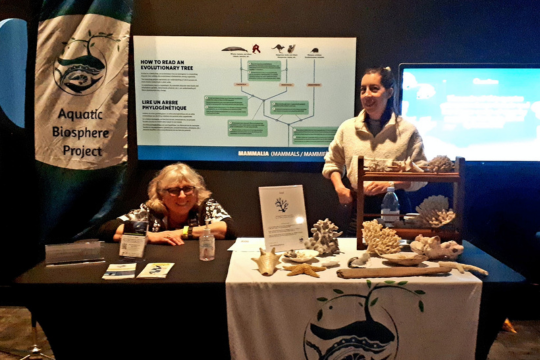
Arie de Jong (right) volunteers with the Aquatic Biosphere Society of Alberta, contributing to projects that support water education and help protect aquatic ecosystems.
Volunteering can take many shapes, as Joanne McKiernan knows well. As the executive director of Volunteer Toronto, she’s constantly seeing ways in which people “show up in community” to do good things.
“Volunteering is one of those ways, but also there are activities that are stepping stones to participation, like knowing your neighbours and connecting with the informal networks around you, doing things that help to organize people around particular themes and activities like clean-up activities, even informal care,” she says. “We’re in a shifting environment [regarding] what we now want to recognize as meaningful contributions and ways for people to stay connected.”
Her organization has a micro-grant program that encourages grassroots, creative projects such as seniors’ groups designed to help other seniors learn to garden on their balconies, art therapy for newcomers that makes connections through common heritage, or even seniors walking clubs.
Those are the less formal ways in which people are volunteering these days, and they often lead participants to also seek out more formal volunteering opportunities.
Meanwhile, all across the country, there are quiet, lesser-known and behind-the-scenes ways in which volunteers contribute to society. McKiernan points to, for example, a peer-support mental health program for farmers. There are people quietly preserving local history, maintaining and building archives and protecting language and culture.
Giving a community a voice
A Filipino group in Toronto, for example, is working to get Filipino community members to engage in the 2026 municipal election. Josel Angelica Gerardo is one of a handful of volunteers in the Filipino Canadian Civic Action Network, which is working to increase Filipino voter turnout.
“We are one of the largest ethnic communities in Toronto and yet, we’ve never had a Filipino councillor or mayor, or at other levels of government,” Gerardo says. “We want to show Filipinos that they do have a voice.”
She says they are visiting Scarborough and North York and hosting workshops on storytelling and identifying the issues that matter to them.
“In between the workshops, we’re going to Filipino summer festivals this summer,” she says.
Gerardo says this work is important to her because she’s a Filipino immigrant.
“My mom came to Toronto as part of the live-in caregiver program because she wanted a better life for my sister and I. I found out that that program was a collaboration between the federal government and the Filipino government and it kind of shaped my life and I thought it was time for our voices to be heard through the government.”
Keeping Indigenous traditions alive
Taylor Behn-Tsakoza, a member of the Dene Nation in Fort Nelson, B.C., is passionate about keeping her culture alive. She spends about 20 hours a week preserving her Indigenous culture through various volunteer roles, including holding hide tanning and language workshops and helping to organize large community events.
“When I think about our language specifically, we only have a handful of fluent speakers left, and I think our youngest fluent speaker is 45,” she says. “Every time we lose an elder, we lose a history book, we lose a dictionary, we lose those old stories that I'm still learning and I don't have yet. I need to put in that time to learn those things.”
In addition to culture and heritage preservers, there are peer support networks for health, caregiving and grief, volunteers contributing to research of all kinds and citizen science projects. A national survey, titled Bringing Meaning to the Volunteer Experience, offers insights on what motivates, sustains and challenges volunteers. Asked what volunteering is, the answers ranged from “offering your time willingly at no cost to help out with a cause, some initiatives or general tasks,” to “about contributing to the well-being of others, addressing needs, fostering positive change, growing as individuals, building connections, empathy and a sense of purpose.” Among the answers of what volunteering looks like were “helping animals find forever homes” and “educational support, environmental protection, community service, disaster relief and other fields aiming to improve society.”
Turtle saviours in Toronto
The Indigenous- and volunteer-led Turtle Protectors Mishiikenh Gizhaasowin has volunteers from many different ethnic backgrounds, ages and genders. In 2025, its volunteers spent more than 3,000 hours working to protect and support local turtle populations, all of which are endangered. Turtle Protectors started when a couple of Toronto residents saw a need, and it’s grown from there.
“Together, we safeguarded 140 turtles who were either nesting or crossing roads and protected 105 snapping and midland painted turtle nests,” said Carolynne Crawley, co-founder of the group, adding that they released a record 1,195 hatchlings into 10 Toronto city parks. “We are strengthening species survival through direct hands-on conservation.”
The group also advocates and leads educational programming for the public and schools to create an awareness about turtles in the city.
Safeguarding biospheres in Alberta
For her part, Arie de Jong has been volunteering for the past eight years with the Aquatic Biosphere Society of Alberta. She’s on the board of the organization and participates in all kinds of initiatives.
One project involves bringing an aquarium to Alberta to enhance water education. She organizes cleanup events in lakes, complete with scuba divers who have pulled surprising things such as microwaves and tires out of lakes.
“And then we track what we find,” de Jong says.
She’s also held educational movie nights and does a lot of mentoring of future volunteers.
“I’m just trying to get the word out, and educate people,” she says. “We’re trying to build a bigger network with more opportunities for education and content.”
All across the country, there are examples of this kind of quiet volunteerism playing out, all for the enrichment of society. Volunteering has also been shown to be advantageous to the health of the volunteers by keeping people moving and thinking, providing a sense of purpose and valuable skills and nurturing new and existing relationships.